- Behind the Counter
- Posts
- AI Threats, Edge Bets, and Checkout Pushback
AI Threats, Edge Bets, and Checkout Pushback
A quick roundup of the latest retail tech news!
Hello Reader,
Another month, another stack of things to pay attention to. This month: Visa wants to process payments for robot shoppers, regulators took a swing at self-checkout kiosks, and WhatsApp is quietly running storefronts in Mexico. We also have cybersecurity, edge computing, and a podcast with strong opinions about the word "frictionless." Let's get into it.
AI Cuts Both Ways
EY's latest Global Cybersecurity Threat Outlook 2026, covered by Retail Insider, paints a clear picture: retail and consumer sectors remain among the most exposed to AI-enabled cyber threats. The combination of high transaction volume, dense customer data, and complex connected systems including payments, loyalty programs, supplier networks, and delivery partners makes retail a prime target. EY's National Leader of Cybersecurity Managed Services in Canada notes that attackers now focus on sectors where breaches cause immediate disruption and generate immediate attention. AI is accelerating that threat, making attackers faster and more efficient, the same way it makes legitimate operations more capable.
Expert POV: We are seeing the tip of the iceberg when it comes to weaponized AI. Protecting your data and your customers' data has never been more important, for defense and for usability alike. Our clients maintain healthy security practices and processes, but the lesson here is to never rest on those. Fraud migrates. Seal the front door, and the attackers start looking for the windows. Then the chimney. Then that air vent that always looked a little suspicious. Anyone who has seen Die Hard knows how this goes. Old holiday movie references aside, this is an age-old battle. Think about how much more efficient AI makes you and your development team, then think about how much more efficient it makes the people trying to break in. That should be more than enough reason to check the vents.

The Channel You Might Be Forgetting | El canal que podrías estar olvidando
🇺🇸 The article argues that WhatsApp Business has evolved from a simple chat tool into a strategic business engine for retailers, covering the full customer journey from first contact through post-sale service. According to a study by Concepto Móvil, while 74% of Mexican companies use messaging for promotional marketing and 73% offer customer service through the channel, only 15% have achieved true digital sales integration. As major consumer events like the 2026 World Cup approach, the article urges retailers to choose messaging providers that integrate with CRMs, ERPs, and payment systems to reduce friction and scale conversational commerce.
Our Perspective: The omnicommerce conversation normally considers brick-and-mortar + e-commerce through the web portal and a mobile application; however the Mexico culture has enabled one more channel: instant messaging. From personal experience, this way of doing retail is not unique to large retail, messaging based commerce happens at all business scales. Tools like WhatsApp Business enable merchants of all sizes to connect with their customers beyond the maze of automated voice services and bring them closer to the business. As culture evolves, retailers find themselves with a new challenge: build loyalty and trust while integrating with the rest of their operations.
🇲🇽 El artículo sostiene que WhatsApp Business ha evolucionado de una herramienta de chat básica a un motor estratégico para el retail, cubriendo todo el recorrido del cliente desde el primer contacto hasta el servicio postventa. Según un estudio de Concepto Móvil, si bien el 74% de las empresas mexicanas utilizan la mensajería para el marketing promocional y el 73% ofrecen atención al cliente a través de este canal, solo el 15% ha logrado una verdadera integración digital de las ventas. Con eventos masivos como el Mundial 2026 en el horizonte, el artículo exhorta a los retailers a elegir proveedores de mensajería que se integren con CRMs, ERPs y pasarelas de pago para reducir fricciones y escalar el comercio conversacional.
Nuestra perspectiva: La conversación de omni-comercio normalmente considera tiendas físicas + comercio en línea a través de páginas web y aplicaciones móviles; sin embargo, la cultura de México ha creado un canal más: servicios de mensajería instantánea. Por experiencia personal, esta opción de hacer retail no es única de compañías grandes, comercio a base de mensajes ocurre a cualquier escala. Herramientas como WhatsApp Business permiten a vendedores de todos los tamaños conectar con sus clientes más allá del laberinto de servicios de voz automatizados y acercarlos más a su negocio. Conforme la cultura avanza, los retailers se encuentran con un nuevo reto: establecer lealtad y confianza manteniendo la integración con el resto de su operación.

Self-Checkout Under Scrutiny
Ohio is considering a bill that would tighten how self-checkout can be used at major retailers. The proposal would require at least one employee for every three self-checkout kiosks, keep at least one staffed lane open, and cap self-checkout purchases at 15 items. It would also block alcohol, tobacco, and certain high-theft items from being purchased at self-checkout. The bill is still in the committee stage, but it’s another signal that self-checkout is moving from “store choice” to “rules-based operation.”
Expert Take: Self-checkout did not fail, but the way it has been deployed in many environments has created real operational friction. The recent wave of legislation is less about slowing down automation and more about correcting an over-rotation that left too little oversight in place. The result is a push toward a more balanced, hybrid approach, staffed lanes alongside attended self-checkout, designed around specific use cases rather than scale alone. The takeaway is clear: checkout can no longer be treated as a single solution. It has to be thoughtfully architected to balance speed, control, and customer experience in a much more constrained and scrutinized environment. Retailers who build that architecture now will be ahead of the ones who wait for the regulations to force their hand.
The Case for Edge
Avassa's piece in Edge AI and Vision lays out a compelling case for in-store edge computing as the foundation for modern retail. Forward-looking retailers are increasingly deploying edge infrastructure to host Internet of Things (IoT) sensors, AI-driven decision tools, and digital signage locally, without routing data back to the cloud and back again. The use cases range from real-time inventory awareness to smart carts that combine cameras, weight sensors, and deep learning models to track items accurately. The core argument is that cloud-only architectures introduce latency and reliability risks that are simply unacceptable for business-critical store applications, and that local edge hosting delivers the speed and resilience that modern operations require.
Our View: Eugene Park, Kitestring's Chief Strategy Officer, has spent 25 years in retail technology, long enough to recognize this debate. The centralization versus decentralization cycle has run through mainframes and dumb terminals, the personal computer revolution, the SaaS wave, and now the edge resurgence. The article is right about the problem and right about the destination, but it is telling a familiar story as though it is a new discovery. What is genuinely new this cycle is not the argument, it is that virtualization has finally solved the management nightmare that made local compute impractical in earlier rounds. A hyperconverged node at the store edge can now run every workload on a single platform, managed centrally, updated remotely, and self-healing when something breaks. That is the actual innovation. The future is a managed hybrid: the store owns resilience and real-time response, the cloud owns analytics, model training, and fleet intelligence. The pendulum does not settle in the middle by accident. It settles there because the physics of the problem point it there. The operators who recognize the pattern are the ones who get ahead.
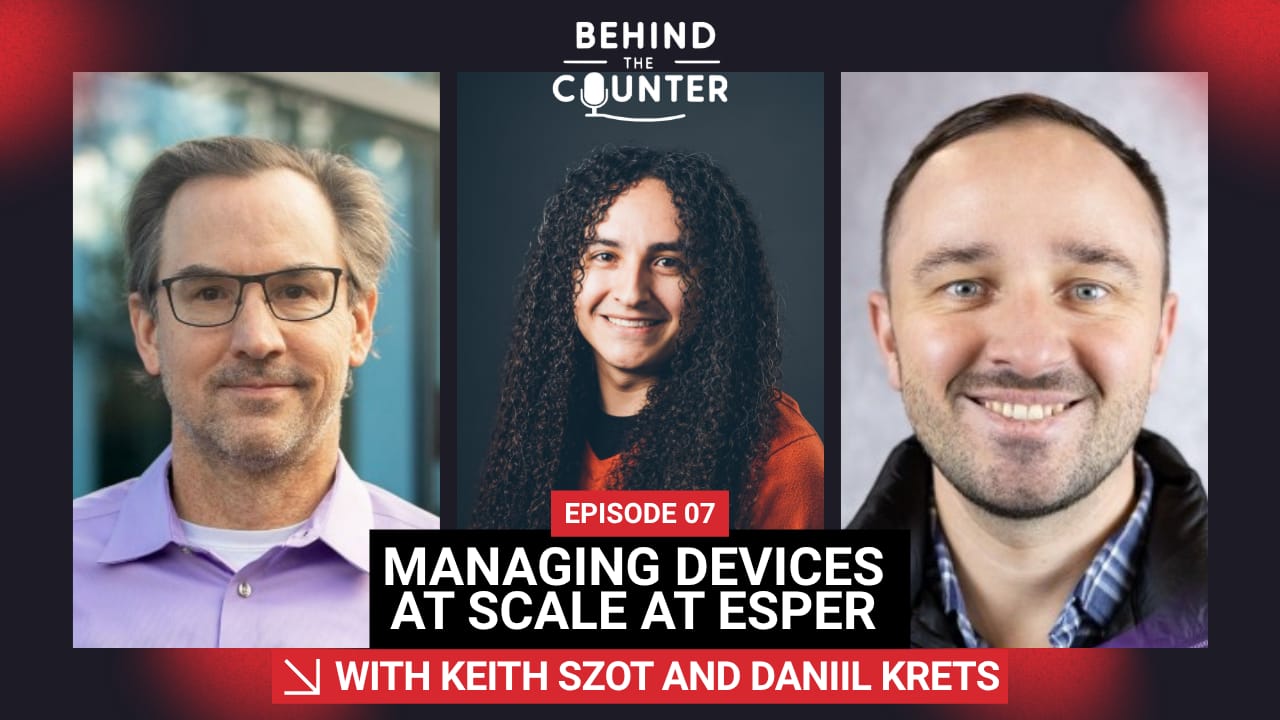
Podcast Pick: Behind the Counter with Esper
This month’s podcast recommendation is our Behind the Counter episode with Keith Szot and Daniil Krets from Esper. We cover shiny tech and AI hype, why “frictionless” is often a myth, and what it really takes to deploy and manage retail and restaurant technology at scale.
What If Your Next Customer Is an Algorithm?
Visa recently unveiled Intelligent Commerce Connect (ICC), a platform built to let AI agents discover merchants and complete purchases on behalf of users across any card network, with no vendor lock-in required. When an AI agent initiates a purchase, ICC replaces the card number with a secure token, verifies the agent is operating within the user's pre-set parameters, and routes the transaction to the appropriate payment network. To stay relevant across a fragmented landscape, the platform supports four competing agentic protocols simultaneously, positioning Visa as a neutral payment layer no matter which standard eventually wins.
Our Take: What if your next customer is not your customer at all? What if it is an algorithm? Most retailers are not ready for that, because being ready is not just a strategy question, it is an architecture question. It requires having an open, Application Programming Interface (API)-driven commerce infrastructure in place for what is coming. Retail has spent 20-plus years optimizing around humans: search, merchandising, store experience, all designed to influence a decision. What happens when the decision-maker is not human? AI agents do not browse your site, walk your aisles, or care about your brand story. Your store is no longer just a shopping destination. It is a fulfillment option being ranked by something that does not care about the brand. The infrastructure for that world is being built right now.
Thanks for Reading!
The common thread this month is accountability. AI shopping agents, checkout regulations, edge infrastructure, and cybersecurity are all forcing the same question: is your operation built for what is actually happening, or for what you planned for two years ago? The retailers moving fastest right now are not the ones chasing new tools. They are the ones making sure their existing foundation can handle what is coming. See you next month.
Enjoyed this issue? Forward it to a colleague and share the insights!